

Skin cancer
About skin cancer
Skin cancer is a common affliction among the Australian population, and we have one of the highest incidences of skin cancer in the world.
It is important to have your GP or dermatologist check any skin lesions you are concerned about, perform a biopsy, and refer you to a specialist dermatologist or plastic surgeon as appropriate.
Procedure details
Types of skin cancer
Basal Cell Carcinoma (BCC) and Squamous Cell Carcinoma (SCC) are the most common types of skin cancer; however, melanoma also presents with alarming frequency.
There are a small number of genetic conditions that predispose people to skin cancer; however, the majority of cases are related to sun exposure.
Sun protection and UV radiation awareness are now ingrained in our society; however, often the damage has been done many years ago when people were actively encouraged to go outside to ‘get some colour’.
Being sun-smart is still important regardless of age to ensure damage is not compounded and perpetuated.
Consultation and pre-operative planning
Your consultation will be held in our Mornington office.
A biopsy may be needed for diagnosis. This is a quick and simple procedure usually done under local anaesthesia.
For a known BCC or SCC, the lesion will be cut out and sent to a pathology lab for examination under a microscope.
Treatment of skin cancers varies according to the type and location.
Topical therapies including cryotherapy, Efudix cream and Aldara cream may be suitable for superficial lesions.
Other lesions may require surgical treatment and reconstructions with skin grafts or flaps.
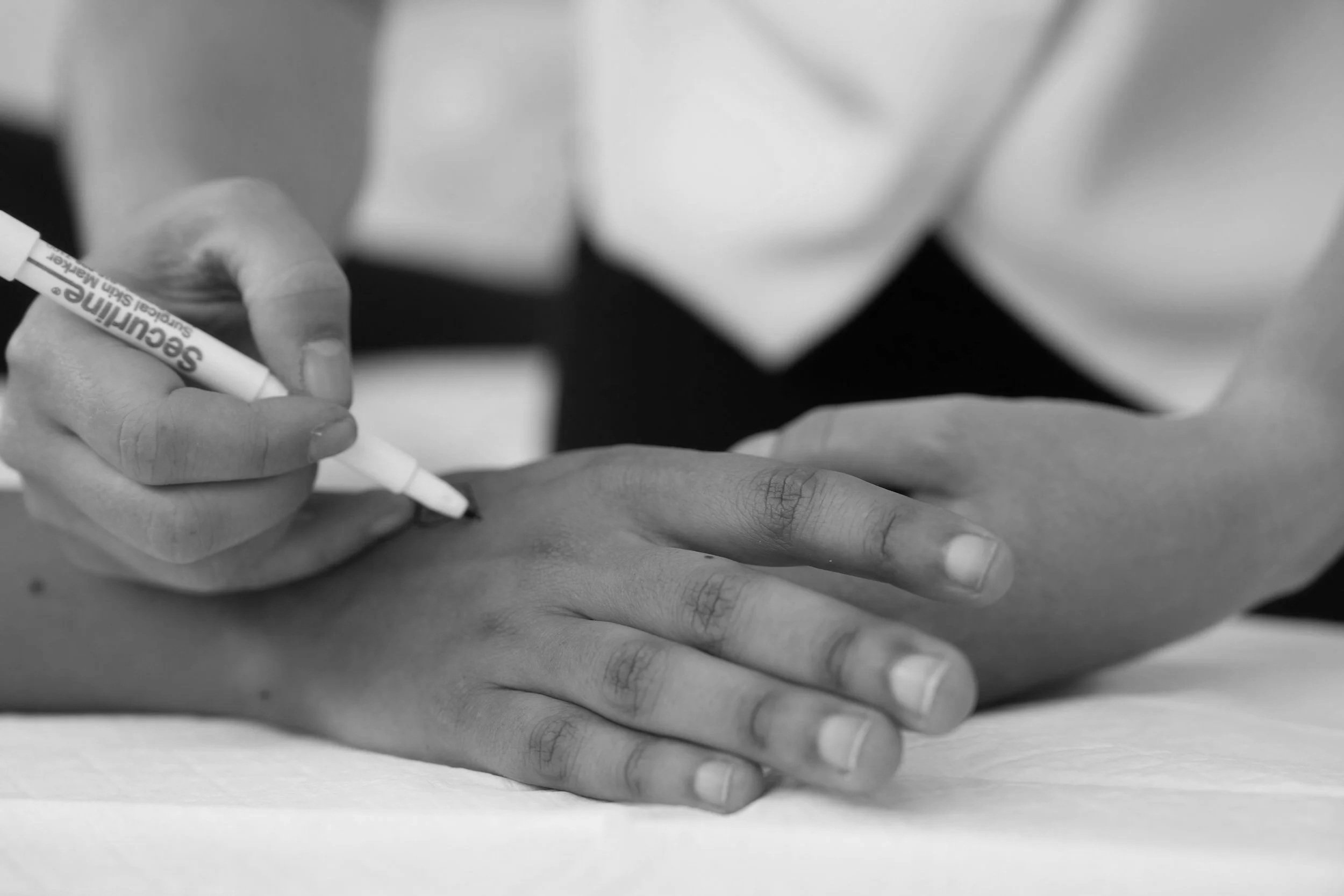
Most skin cancers are removed surgically.
Surgical technique
Depending upon the cancer and the extent of the procedure, surgery for the removal of skin cancer can be performed as in-room procedures, a day case, or alternatively with a short hospital stay.
If the cancer is small, the procedure can be done quickly and easily. The procedure may be a simple excision, which usually leaves a thin, barely visible scar. If examination shows that all the cancer cells have been removed, you may not need further treatment aside from ongoing skin surveillance with your GP.
For a suspected melanoma, the surgeon may remove all or part of the lesion. It is then sent to a laboratory so a pathologist can examine it under a microscope. Depending on the pathologist’s report, a wider excision (that is, taking more skin more deeply) may be recommended. In this case, a skin graft or a skin flap may be required to repair a large area of skin. Some melanomas present in a more advanced form and necessitate discussion on local lymph node sampling (Sentinel Node biopsy). This helps to stage the disease and acts as a guide to any additional treatment (e.g. immunotherapy) that you may require.
Recovery and results
Canvas Plastic Surgery will ensure you are provided with tailored instructions for your specific post-operative care.
Depending on the extent of the procedure, you may be able to go home the same day. With more complex cases and where skin grafts are needed, you may have to stay overnight in hospital or for a few days.
In the case of minor procedures, you may experience some pain and mild discomfort. If a large skin cancer has been removed or a skin graft performed, discomfort and pain may be significant. Pain relief may be required for several days.
It is normal to experience bruising and swelling. This will usually settle down in the week after surgery.

Other considerations
-
There may be complications from surgery and thankfully, the majority of these are extremely rare.
The Canvas Plastic Surgery Team will explain any potential complications during the pre-operative planning process and commit to supporting you throughout your recovery period.
-
The most important message in skin cancer treatment is prevention.
With this belongs education, awareness, early detection and then appropriate management.
We welcome you to speak with us to obtain specific information about our processes.
The Foundation for Plastic Surgery and the Cancer Council have a wealth of information for patients.